
Volta Gold Coffee Estates
Pioneering Fine Robusta Production on Ghana's Volta Lake
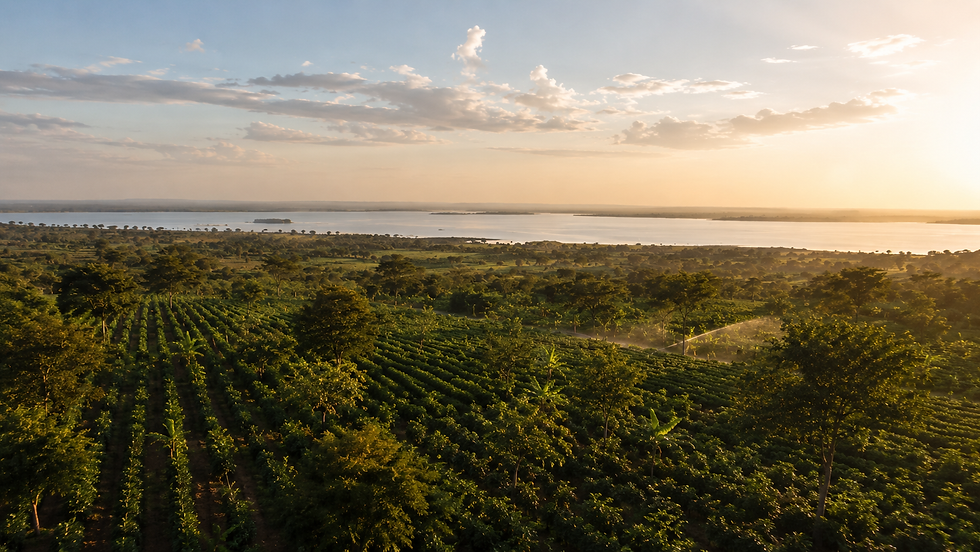
A large-scale, irrigated Fine Robusta coffee estate in Ghana’s Volta Economic Corridor, combining professional agronomy, avocado shade, localized wet processing, centralized dry milling, and Atlantic export logistics to establish Ghana as a serious new Robusta origin.
Ghana's Next Frontier
From Volta Lake to
Global Coffee Markets
Volta Gold is a proposed 10,000-acre irrigated Fine Robusta coffee estate on Ghana’s Volta Lake, designed to create a new professionally managed coffee origin in West Africa.
Located in the Volta Economic Corridor on the Afram Plains, the venture combines flat agricultural land, irrigation, avocado shade, localized wet processing, centralized dry milling, and export logistics to Tema Port.
The first phase is large enough to become a national demonstration project before scaling toward 100,000 acres and beyond.

$150M
CapEx Requirement
13,750
Tons of Green Bean Output
10,000
Acres at Initial Scale
8,800+
Direct and Seasonal Jobs
The Project
A New Robusta Origin
for a Changing Coffee Market
Global coffee supply is becoming more volatile as drought, heat, irregular rainfall, and crop stress affect several major producing regions. Robusta is more heat-tolerant than Arabica, does not require high elevations, and is the natural coffee crop for Ghana’s warmer lowland conditions.
Ghana has suitable Robusta-growing zones, strong Atlantic export logistics, millions of acres of fertile land, and direct access to Volta Lake irrigation. The opportunity is to develop a large, professionally managed Fine Robusta estate that can supply resilient, traceable green coffee to European and American buyers.
Volta Gold would begin as a 10,000-acre estate, meaningful enough to establish Ghana as a serious new coffee origin, but still small enough to finance, execute, and de-risk before expansion.
Climate Resilience
A professionally managed Robusta estate using Volta Lake irrigation to reduce dependence on increasingly volatile rainfall.
Localized Wet Processing
Coffee cherries processed close to the plantation in small wet mills, preserving quality and reducing post-harvest losses.
Avocado Shade System
Coffee grown under 30% avocado shade, combining crop protection, biodiversity, and an additional high-value export crop.
Atlantic
Export Logistics
A Ghana origin with access to Tema Port, shorter routes to Europe and the U.S., and traceable green coffee for global buyers.

ESG & Social Impact
Commercial Scale with Development Impact

Employment Creation
A labor-intensive Fine Robusta estate will create 2,800 full-time and 6,000 seasonal jobs across nursery operations, planting, irrigation, pruning, harvesting, wet processing, dry milling, logistics, maintenance, and support services.
Community & Farmer Integration
Where appropriate, Volta Gold can integrate surrounding communities and smallholder farmers through seedlings, agronomic training, wet-processing access, quality protocols, and structured routes to premium export markets.
Climate Resilience
An irrigation-led production system supported by Volta Lake water access, avocado shade, professional pruning, nutrition, and distributed wet-processing infrastructure will reduce exposure to rainfall volatility and localized climate shocks.
Volta Corridor Transformation
Volta Gold is designed to align with Ghana’s 24-Hour Economy and Volta Economic Corridor agenda by turning underutilized land into productive agricultural infrastructure, linking plantation clusters to processing and export logistics, and creating a replicable model for agro-industrial modernization along Volta Lake.


Project Location
Ghana's Volta Lake Corridor
The project is focused on Ghana’s Afram Plains / Volta Lake area,
within the broader Volta Economic Corridor, where large tracts of flat agricultural land can be developed for irrigated Fine Robusta production.
The area offers suitable lowland conditions for Robusta, access to Volta Lake water for irrigation, proximity to power and inland logistics, and a route to Tema Port for export-oriented green coffee production.

Volta Lake - Afram Plains
Fine Robusta production area anchored by irrigation, fertile lowlands, and export logistics.

Flat Land for Scalable Estates
The Afram Plains offer large tracts of flat agricultural land suitable for irrigated estate development and future expansion.

Volta Lake Irrigation Potential
Direct access to Volta Lake creates the basis for irrigation-supported coffee production, reducing reliance on increasingly volatile rainfall.

Lowland Fine Robusta Suitability
Robusta is well suited to Ghana’s warmer lowland conditions.

Corridor-to-Port Logistics
The Volta Economic Corridor provides a strong location for plantation clusters, processing infrastructure, inland logistics, and export routes to Tema Port.
Project Sponsors
Volta Gold is being advanced through a combination of international project-development experience, Ghanaian land-development and execution capacity, and a network of coffee agronomy, irrigation, processing, and financial specialists.

Project Sponsor / Founder

Local Operating Partner
Anticipated Partners
Volta Gold is being developed around a targeted technical network spanning feasibility studies, engineering, climate analysis, environmental studies, surveying, irrigation, agronomy, processing, and implementation support, with each discipline contributing to an investment-grade development pathway.

Feasibility Studies

Project Financing

Agronomic Support

Engineering and Project Delivery (EPCM)

Climate and Environmental Analytics

Agronomy & Plantation
Design

Surveying & Cadastral Mapping

Civil Works

Irrigation Systems

Laboratory Services

LiDAR mapping

Legal Advisors

Environmental Studies (ESIA)


Mill Equipment Manufacturers
Why Ghana?
Ghana offers a rare combination of suitable lowland Robusta conditions, Volta Lake irrigation potential, available flat land, rural labor, Atlantic export logistics, and a national policy push toward agro-industrial development.
While coffee is already cultivated in Ghana, production remains extremely small, fragmented, and far below the country’s potential. With the right estate model, Ghana could become a West African analogue to Vietnam's Robusta success story.
Advancing Ghana’s
24-Hour Economy Agenda
Volta Gold is designed to fit Ghana's 24-Hour Economy and Grow24 Agenda,
which seeks to transform more than 5 million acres of land across the Volta Economic Corridor
into a major agro-industrial growth zone, anchored by irrigated plantations, processing infrastructure, logistics, and export-led value chains.
